


Introduction
A bank or insurer operating critical infrastructure, or a payment institution with significant digital service dependencies, can find itself squarely inside the scope of both DORA and NIS2 at once. The two regimes were negotiated separately, sit under different supervisory authorities in most member states, and use different terminology - yet both ultimately demand the same underlying capability: continuous, demonstrable control over ICT risk, incident response, and third-party dependencies. Organizations that treat them as two unrelated compliance programmes end up duplicating evidence-gathering work that could largely be unified.
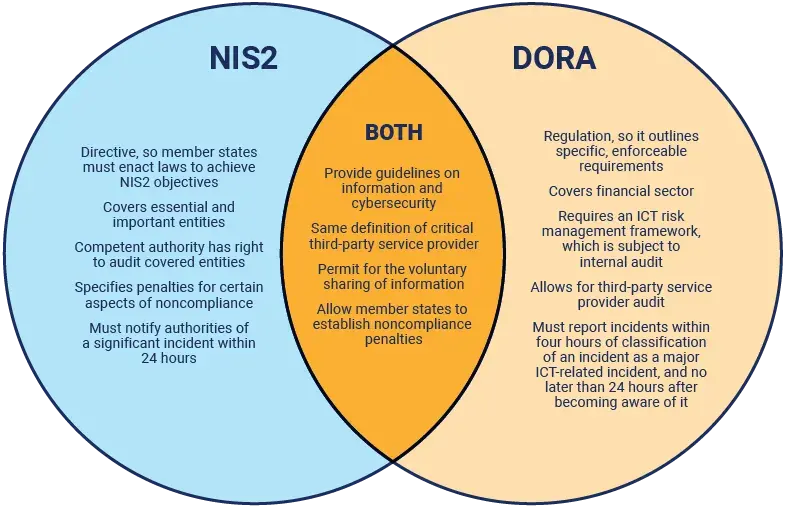
Where the Two Regimes Actually Overlap
- Incident reporting: both require rapid classification and notification of significant incidents, on similar but not identical timelines and thresholds
- Third-party and supply-chain risk management: DORA's Register of Information and NIS2's supply-chain security measure both require mapping and monitoring of critical vendor dependencies
- Risk management frameworks: both mandate a documented, regularly tested ICT risk management approach covering identification, protection, detection, response, and recovery
- Resilience testing: DORA's threat-led penetration testing regime and NIS2's expectation of tested incident response procedures both require evidence of active, not theoretical, testing
Where They Genuinely Diverge
The overlap is real but not total, and treating the two regimes as fully interchangeable creates its own risk. DORA's incident reporting thresholds and timelines are specific to financial entities and calibrated around systemic financial stability, while NIS2's are sector-general. DORA's Register of Information has a defined structure and submission expectations that NIS2's supply-chain measure does not mirror exactly. A unified evidence approach has to be built to satisfy the stricter requirement in each overlapping area, not an averaged or generic version of both.
What a shared evidence layer actually looks like
Rather than maintaining separate evidence trails for DORA examiners and NIS2 supervisors, dual-regulated entities are better served by a single underlying system of record - continuously updated, cryptographically verifiable, and structured so that the same underlying evidence of an incident, a control, or a vendor relationship can be presented in the specific format each regulator expects, without re-collecting or re-verifying the same facts twice. The efficiency gain is real, but the more important benefit is consistency: two audits pulling from two independently maintained spreadsheets are far more likely to surface contradictions than two audits pulling from one continuously verified source.
- Map exactly where DORA and NIS2 obligations overlap for your specific entity type before designing a unified evidence approach
- Build to the stricter of the two requirements wherever they diverge, rather than a generic middle ground
- Maintain one continuously updated, verifiable evidence source rather than parallel spreadsheets for each regulator
- Treat consistency across regulators as a risk-reduction goal in its own right, not just an efficiency gain
Dual-regulated financial entities don't need two compliance programmes - they need one evidence layer strong enough to satisfy both. See how ROOTKey unifies DORA and NIS2 compliance evidence.
Get cyber-resilience insights in your inbox
Practical, audit-ready guidance on data integrity, compliance and continuity - delivered as we publish.