
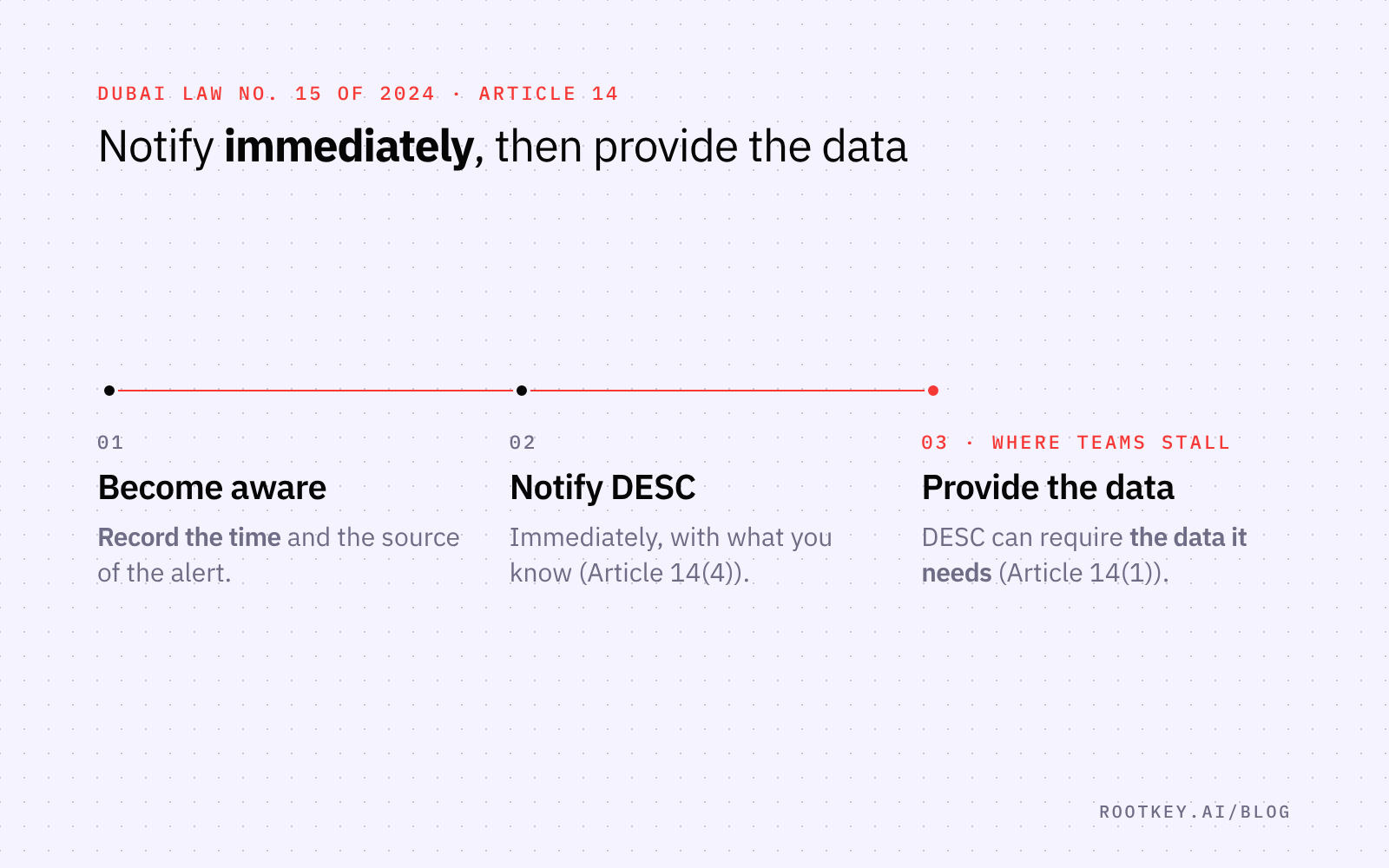
Law No. (15) of 2024 Concerning the Dubai Electronic Security Centre, issued on 4 September 2024, sets the rules for electronic security across Dubai's government and critical sectors. It applies to government entities and to private companies that the Dubai Electronic Security Centre (DESC) classifies as critical, and it requires them to notify DESC immediately of threats, hacks, leaks, interceptions and risks. The law gives no number of hours. Immediately means you report what you know as soon as you know it, and keep reporting as you learn more.
Who is covered
- Government entities: government departments, public agencies, free zone authorities and similar bodies.
- Critical non-government entities: private companies licensed in Dubai, its special development zones or free zones, that DESC classifies as critical.
- Other private companies, indirectly: a government entity that oversees non-government entities must set security controls for them, have DESC approve those controls and verify compliance (Article 15).
The law gave the entities it governs one year from its entry into force to comply, so that window has now passed.
What the law asks of covered entities
- Comply with DESC's rules, provide DESC with the data it requires and cooperate fully (Article 14(1)).
- Notify DESC immediately of threats, hacks, leaks, interceptions or risks (Article 14(4)).
- Connect to DESC's security operations centre, or to another centre DESC certifies (Article 14(5)).
- Assign electronic security staff who report to the entity's highest authority (Article 14(6)).
- Use only DESC-certified private electronic security companies, and DESC-authorised information security officers (Article 14(8) and (9)).
- Do not disclose electronic security data to third parties without DESC's written approval (Article 14(7)).
DESC also develops Dubai's Information Security Regulation and audits compliance with it (Article 6). In an emergency it can monitor, disable or block systems, informing the judicial authorities within a week (Article 13). Penalties are set by a resolution of the Chairman of the Executive Council (Article 19).
Immediately, then accurately
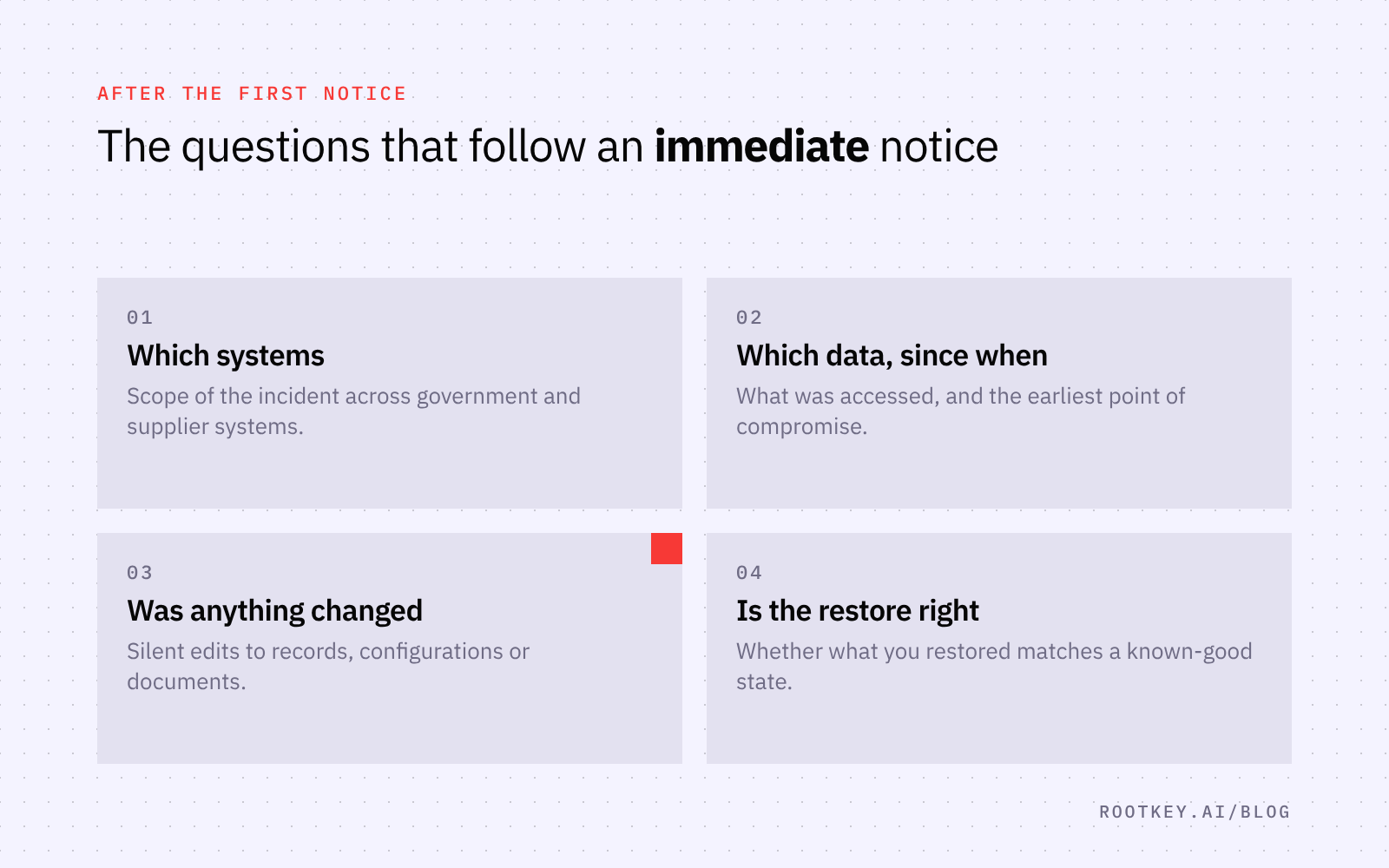
A rule without a fixed number of hours is not a softer rule. It means the first notice will be incomplete, and the follow-up questions will come fast: which systems, which data, since when, was anything changed, and what did you restore? Article 14(1) lets DESC ask for the data it needs, so the answers have to exist somewhere other than in people's memory.
The question that takes longest is usually the integrity one. Encryption and outages are visible. Silent changes to records, configurations or documents are not, and proving they did not happen is harder than proving they did, unless you recorded the state of your data beforehand, outside the systems under investigation.
What to have ready
- Confirm your status: whether DESC has classified you as critical, or whether a government entity you serve has set controls for you under Article 15.
- Write the notification path: who decides, who contacts DESC, and how the time of awareness is recorded.
- Keep an inventory of systems and data that you can share with DESC on request.
- Record a verifiable state of critical data and configurations, kept outside the environment it describes.
- Rehearse the first hour: a notice with incomplete facts, followed by updates.
For the federal and financial-sector picture in the UAE, see UAE PDPL and the ADGM Cyber Risk Framework.
Where ROOTKey fits
ROOTKey records a sealed fingerprint of files and records in an independent registry and shows what changed, who changed it, when and from where. After an incident, that is the evidence behind the follow-up answers: which data was altered, which was not, and which verified version to restore. ROOTKey deploys as SaaS, in a private cloud or on-premise.
If you work with Dubai government entities, talk to our team.
Sources
- Dubai Legislation Portal: Law No. (15) of 2024 Concerning the Dubai Electronic Security Centre%20of%202024%20Concerning%20the%20Dubai%20Electronic%20Security%20Centre.html)