

Section 3.3.10, Data Backup and Recoverability, is the part of the Saudi Central Bank's (SAMA) Cyber Security Framework that governs how banks, insurers, financing companies, credit bureaus and financial market infrastructure back up and recover data. Its principle is that backup and restoration should ensure the reliability, availability and recoverability of data. In practice it asks for a strategy, approved and measured procedures, defined recovery time objectives (RTOs) for critical services, and periodic testing that backup media can actually be recovered.
Who it applies to
The framework, issued by SAMA in May 2017 and maintained in SAMA's rulebook, applies to all SAMA-regulated member organisations: banks, insurance and reinsurance companies, financing companies and credit bureaus operating in Saudi Arabia, and the financial market infrastructure. A few sections are excluded for non-bank institutions; 3.3.10 is not one of them.
What 3.3.10 asks for
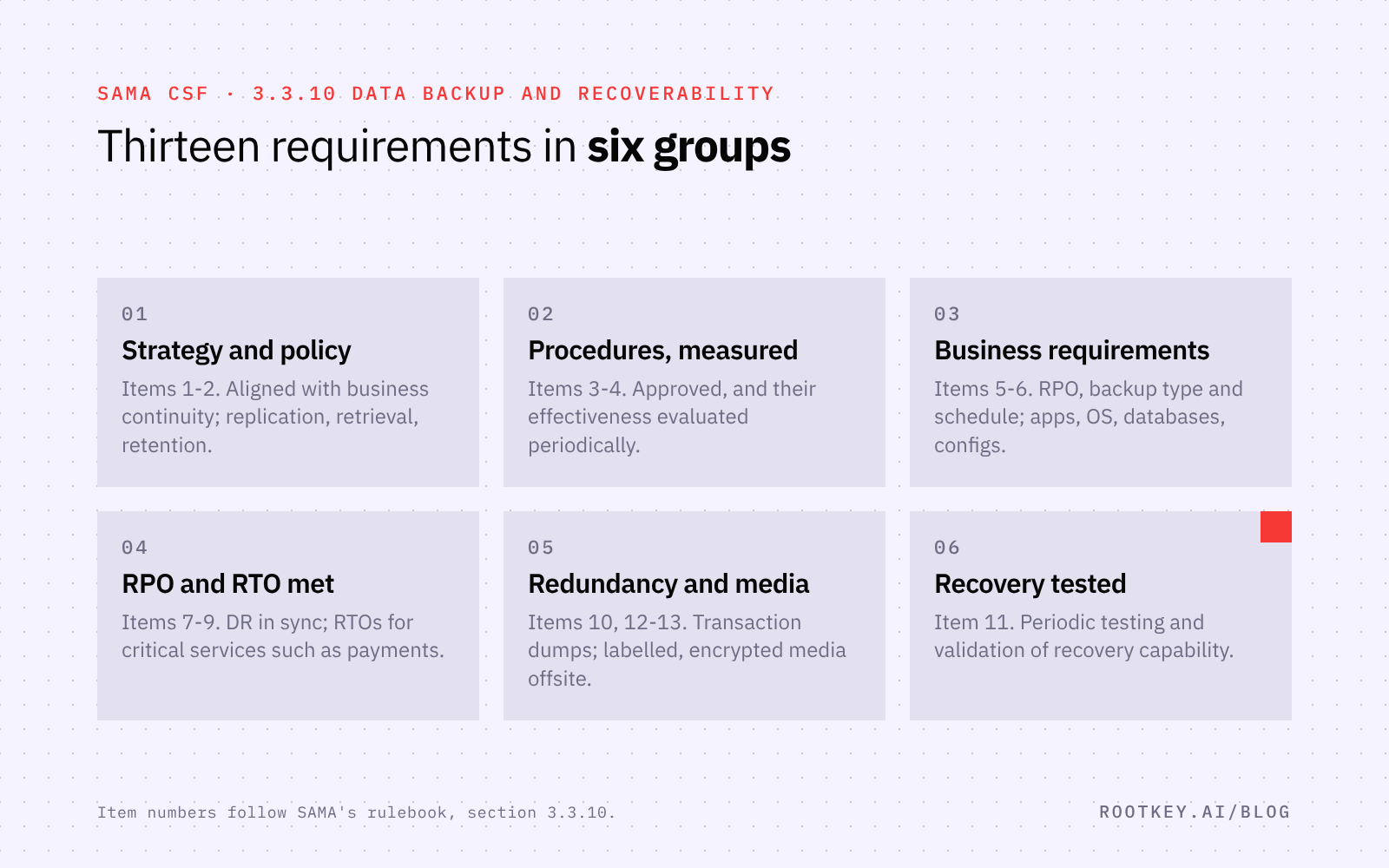
- A backup management strategy and policy, aligned with SAMA's business continuity requirements and covering replication, storage, retrieval and retention.
- Approved backup and restoration procedures, whose effectiveness is measured and evaluated periodically.
- Requirements set by the business: legal and regulatory needs, the agreed recovery point objective (RPO), the type of backup (offline, online, full, incremental) and the schedule.
- A minimum scope: applications, operating system software, databases and device configurations.
- Recovery that meets its targets: disaster recovery data kept in sync with the primary site per the agreed RPO and RTO, RTOs defined for critical services such as payments, and enough people, process and technology to achieve them.
- Redundancy and media handling: alternate mechanisms such as transaction dumps, labelled media, and encryption of sensitive backup media before it goes offsite.
- Periodic testing and validation of the recovery capability of backup media.
What the recovery test should prove
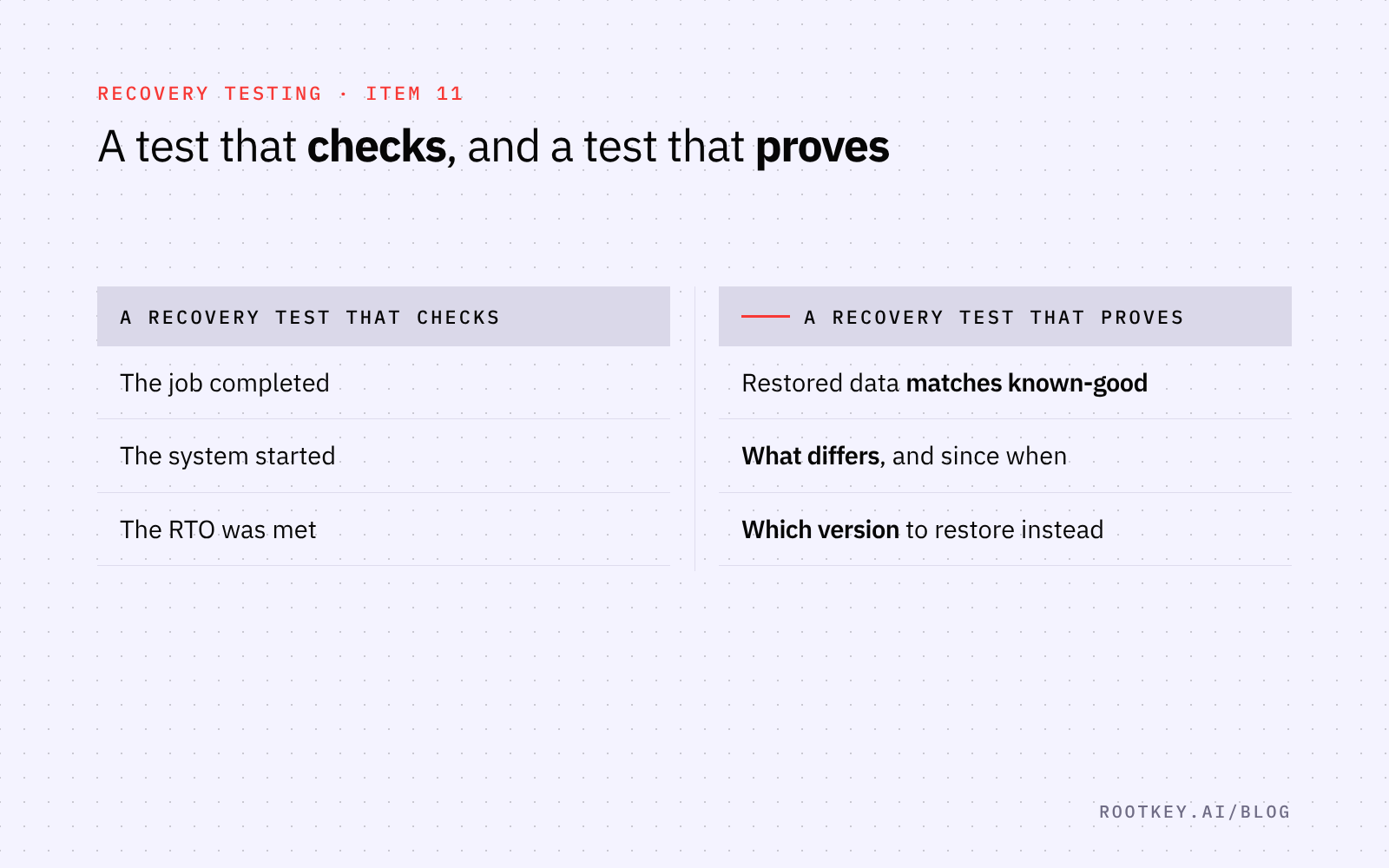
Item 11 asks for periodic testing and validation of recovery capability. Most tests answer one question: did the data come back within the RTO? An examiner, and a board after an incident, will ask a second one: is the data that came back correct?
The difference matters most in the scenario the framework exists for. If an attacker changes transaction or customer records before encrypting systems, every backup since the change holds the altered version. The restore meets its RTO and restores the problem. A recovery test that compares restored data with an independently kept reference closes that gap.
Evidence an examiner can check
- The approved strategy, policy and procedures, with dates and owners.
- RPO and RTO for each critical service, and test results measured against them.
- A record of each recovery test: scope, date, result and the integrity check performed.
- Replication status between primary and disaster recovery sites, and how issues were resolved.
- An inventory of labelled backup media, and proof that media sent offsite was encrypted.
For the cross-sector controls that now apply to private companies in the Kingdom, see NCNICC-1:2025 Backup Controls.
Where ROOTKey fits
ROOTKey records a sealed fingerprint of files and records in an independent registry before an incident. After a restore, it compares the result with that reference and shows what changed, who changed it, when and from where, so a recovery test produces evidence of correctness, not just completion. Where something was altered, you can restore the last verified version of a single file or row. ROOTKey deploys as SaaS, in a private cloud or on-premise.
If you are preparing for a SAMA review, talk to our team.