
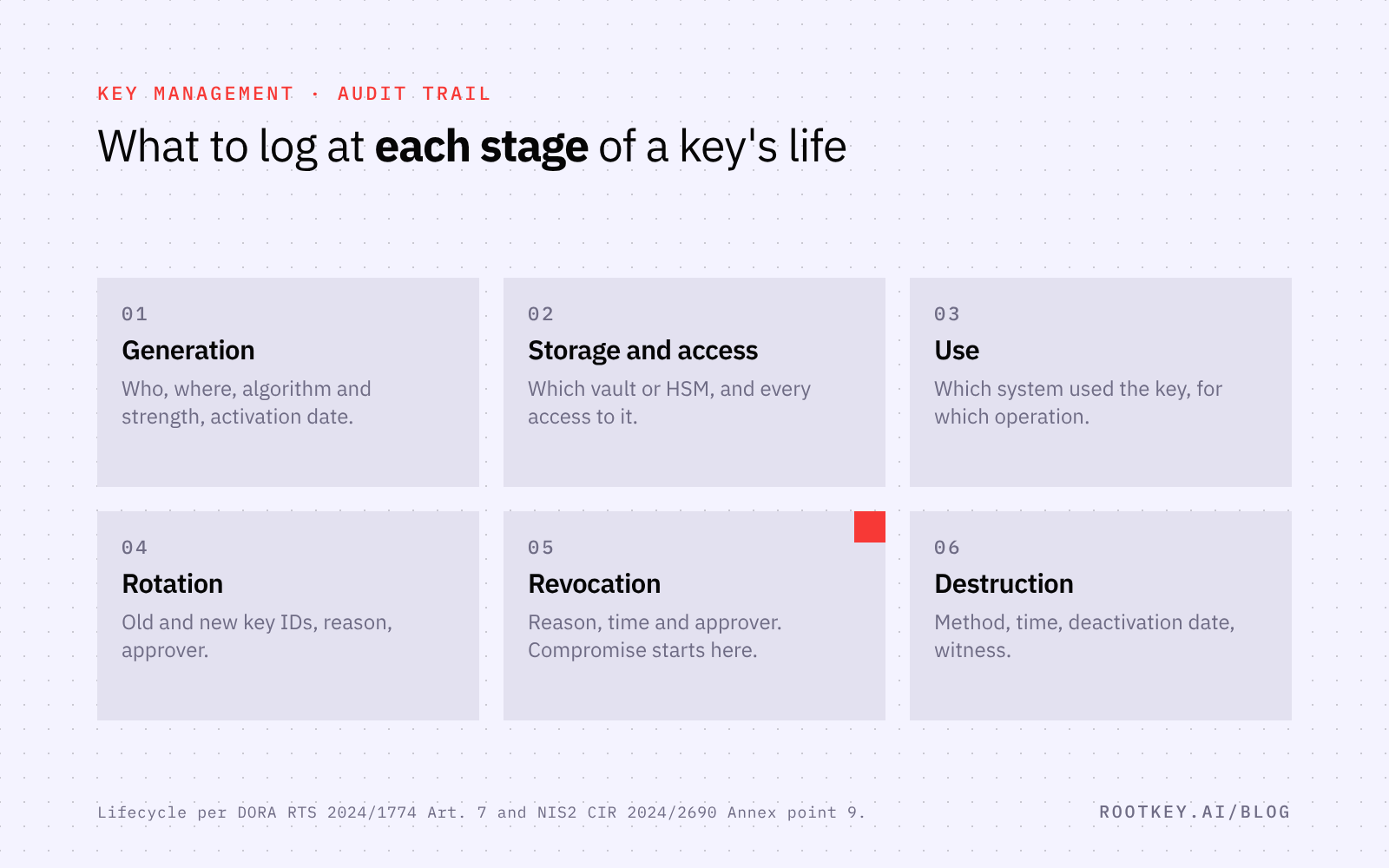
A key management audit trail is the record of what happened to each cryptographic key and certificate over its life: when it was generated and by whom, where it was stored, when it was used, rotated, revoked and destroyed. Under the EU's DORA and NIS2 rules, financial entities and many essential and important entities must manage keys across that whole lifecycle, and NIS2's implementing regulation lists logging and audit among the steps a key management policy has to cover.
What the rules say
DORA: Delegated Regulation (EU) 2024/1774, Article 7
- A key management policy that covers the whole lifecycle: generation, renewal, storage, backup, archiving, retrieval, transmission, retirement, revocation and destruction.
- Controls that protect keys against loss, unauthorised access, disclosure and modification, designed from data classification and the ICT risk assessment.
- Methods to replace keys that are lost, compromised or damaged.
- A register of all certificates and certificate-storing devices, at least for ICT assets that support critical or important functions, kept up to date.
- Prompt renewal of certificates before they expire.
NIS2: Implementing Regulation (EU) 2024/2690, Annex point 9
For the entities it covers, mainly digital infrastructure, ICT service management and digital providers, the implementing regulation requires a cryptography policy that sets approved algorithms and key strengths and, where appropriate, a crypto-agility approach. Its key management practices run from generation and certificate issuance through storage, change, compromised keys, revocation, recovery, backup and archiving to destruction, and include logging and audit of key management activities and the recording of activation and deactivation dates.
For other NIS2 entities, Article 21(2)(h) of the directive still requires policies and procedures on cryptography and, where appropriate, encryption.
Why the audit trail itself needs protecting
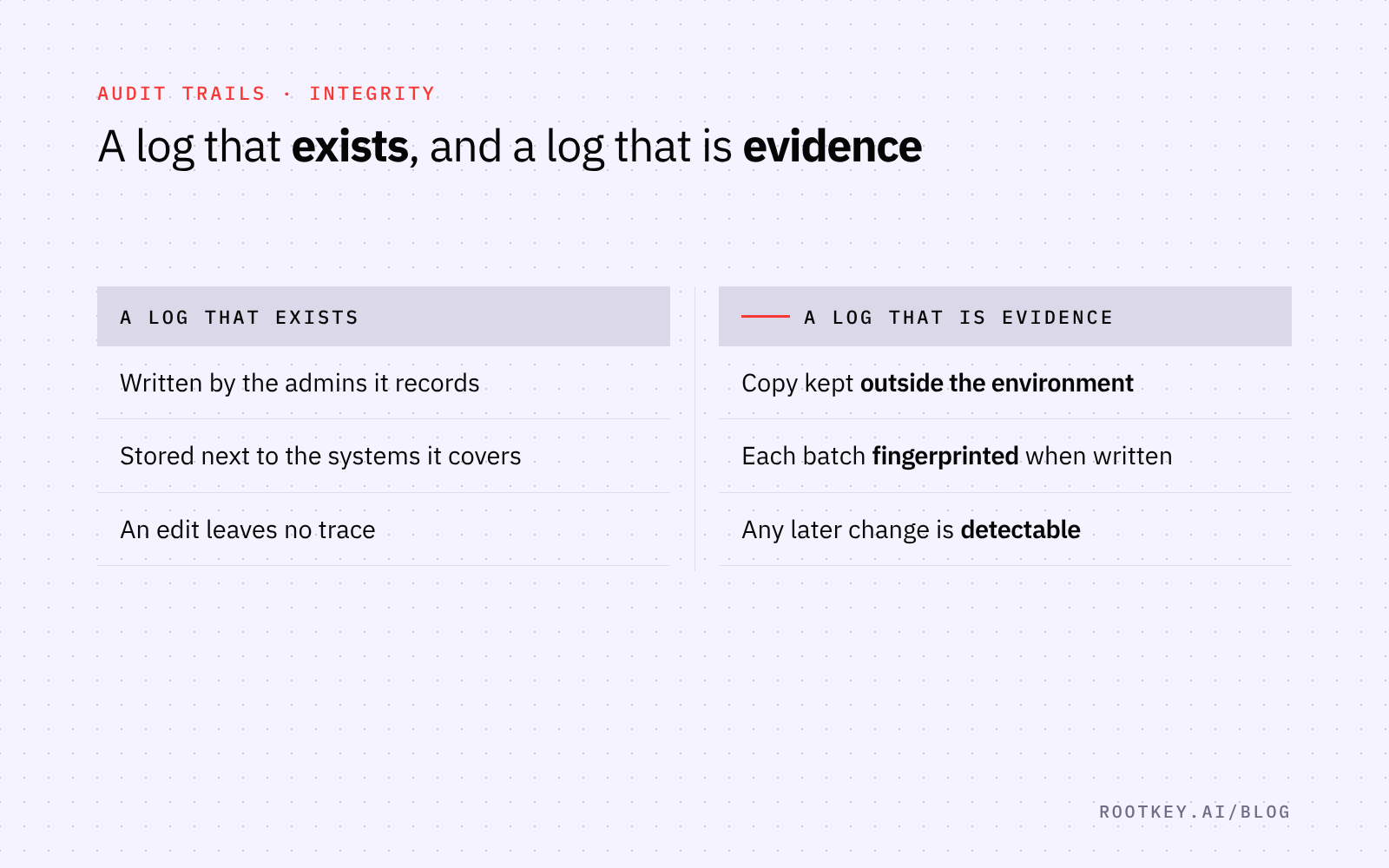
An audit trail is only evidence if nobody could have edited it. Key management logs are a prime target: an attacker who misuses a key has every reason to remove the trace, and the administrators who manage keys often also manage logging.
Two practices help. Keep a copy of the trail outside the environment that produces it, and record a fingerprint of each log batch when it is written, so any later edit is detectable. The same logic applies to the certificate register DORA requires: a register that can be quietly changed is weak evidence of what was in it.
A practical checklist
- Inventory every key and certificate, with owner, purpose and expiry. Start with critical or important functions.
- Log each lifecycle event with who, what, when and from where.
- Separate duties: the people who use keys should not be able to edit the log of their use.
- Fingerprint log batches and the certificate register, and keep the fingerprints outside the perimeter.
- Review the policy at planned intervals, and alert on certificates that approach expiry.
- Plan for algorithm change. Our post on the FIPS 140-2 sunset covers the crypto inventory side.
Our DORA and NIS2 pages cover both regimes in full.
Where ROOTKey fits
ROOTKey seals fingerprints of files and records, such as log exports or a certificate register kept in SharePoint, OneDrive, Amazon S3 or Cloudflare R2, in an independent registry outside your systems and ours. If an entry is changed later, ROOTKey shows what changed, who changed it, when and from where.
If your key management evidence is on the audit plan, talk to our team.