
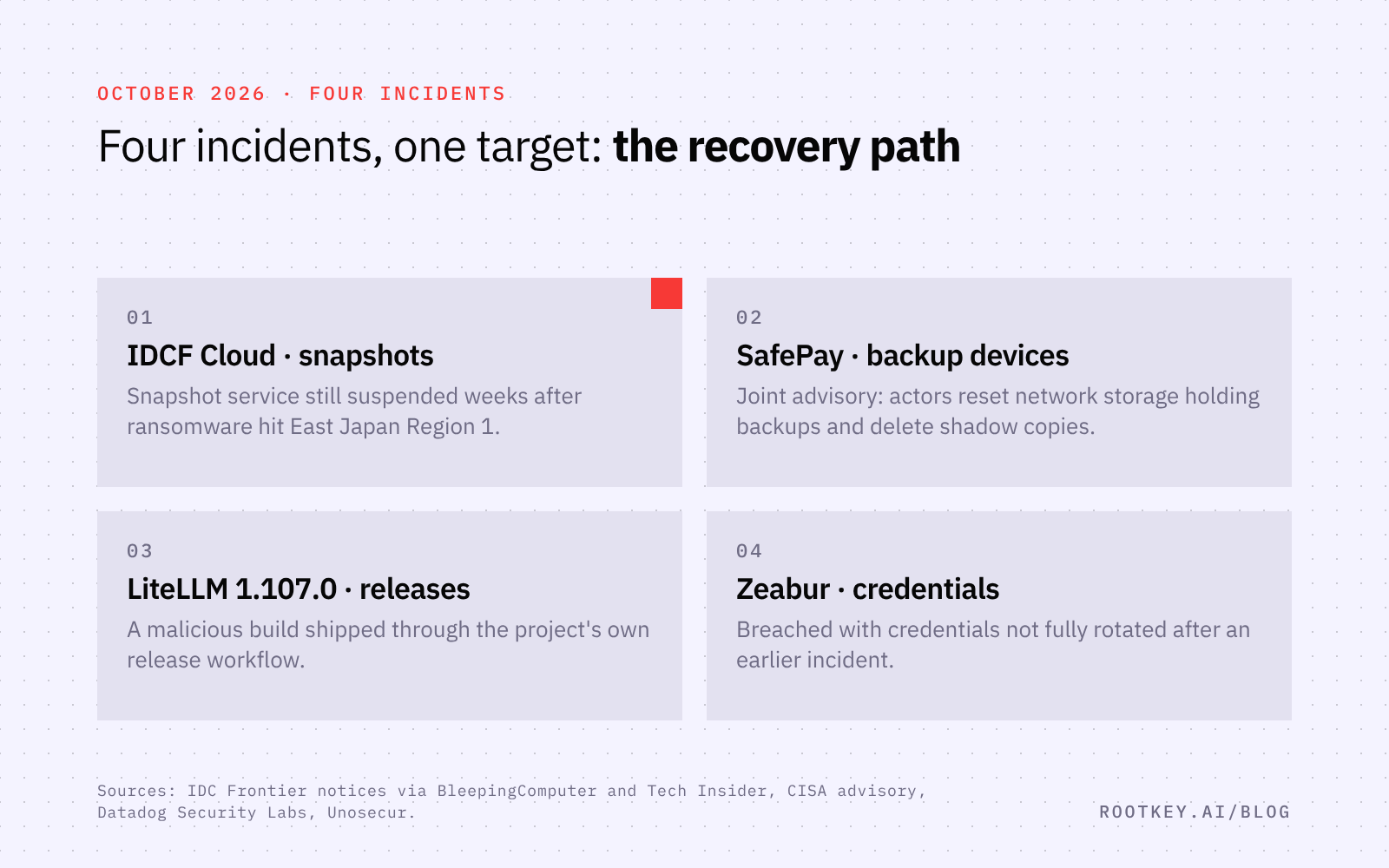
Several of October 2026's most disruptive incidents shared a target: the systems organisations count on to recover. A Japanese cloud provider had to suspend its snapshot service. A joint advisory on the SafePay ransomware group named backup devices among the things the group resets. A widely used AI library shipped a malicious release through its own official channels. And a hosting platform was breached with credentials that should have been rotated two months earlier.
None of these techniques is new. Seen together, they show how often the way back is now part of the attack.
IDCF Cloud: when the snapshots sit inside the blast radius
On 7 October, IDC Frontier, the SoftBank company that runs IDCF Cloud, shut down systems in its East Japan Region 1 after what it confirmed was a ransomware attack by a third party. BleepingComputer reported that 495 companies and local governments were affected. The attackers claimed to have wiped more than 554,000 snapshots; the company has not confirmed that figure.
What the company's own updates do show is a recovery path under strain. Its backup service resumed on 18 October, while the snapshot function was still suspended at the start of November, according to Tech Insider's tracking of the notices. Copies that live with the provider, in the same region and under the same control plane, can fall with it.
SafePay: the advisory names the backups
On 21 October, CISA and the FBI published a joint advisory on SafePay with the US Secret Service, the UK's National Crime Agency, Germany's Landeskriminalamt Rheinland-Pfalz and the North West Regional Organised Crime Unit. The group has hit at least 600 organisations across critical infrastructure sectors since August 2024, as BleepingComputer summarised. The advisory is explicit about recovery: it says SafePay actors disrupt recovery operations "by deleting shadow copies and resetting network-attached storage devices containing backups."
That sentence is the month in one line. The attack plan includes your restore.
LiteLLM: an official channel shipped an untrusted build
Also on 21 October, a malicious LiteLLM 1.107.0 was published to PyPI and to the project's container images. Datadog Security Labs puts the exposure at about two hours. According to the project's analysis, as summarised by Datadog, the attackers used stolen GitHub CLI tokens to run LiteLLM's own release workflow against a look-alike fork, and the published artifacts carried build provenance pointing to that fork. The package installed a credential stealer that runs every time Python starts.
The lesson is not specific to AI tooling. Coming from the official source is a statement about the channel, not about the content. The only way to know an artifact is what you expect is to check it against a reference recorded independently of the pipeline that produced it.
Zeabur: a recovery that left the door open
Hosting platform Zeabur was breached on 14 and 15 October with leaked internal credentials. Its investigation, as reported by Unosecur, found that credentials had not been fully rotated after an earlier incident in August. An incident that is closed without verifying the state you returned to can leave the previous compromise in place.
What the month adds up to
Every recovery plan rests on assumptions: the snapshots are there, the backup devices are intact, the release is the one the maintainers built, the credentials are clean. October tested each one. When an attacker plans for your recovery, a restore that completes is no longer evidence that you recovered the right thing.
We made the same argument in Data Recovery Is Not Data Integrity Verification. This month supplied the examples.
Five checks for your recovery path
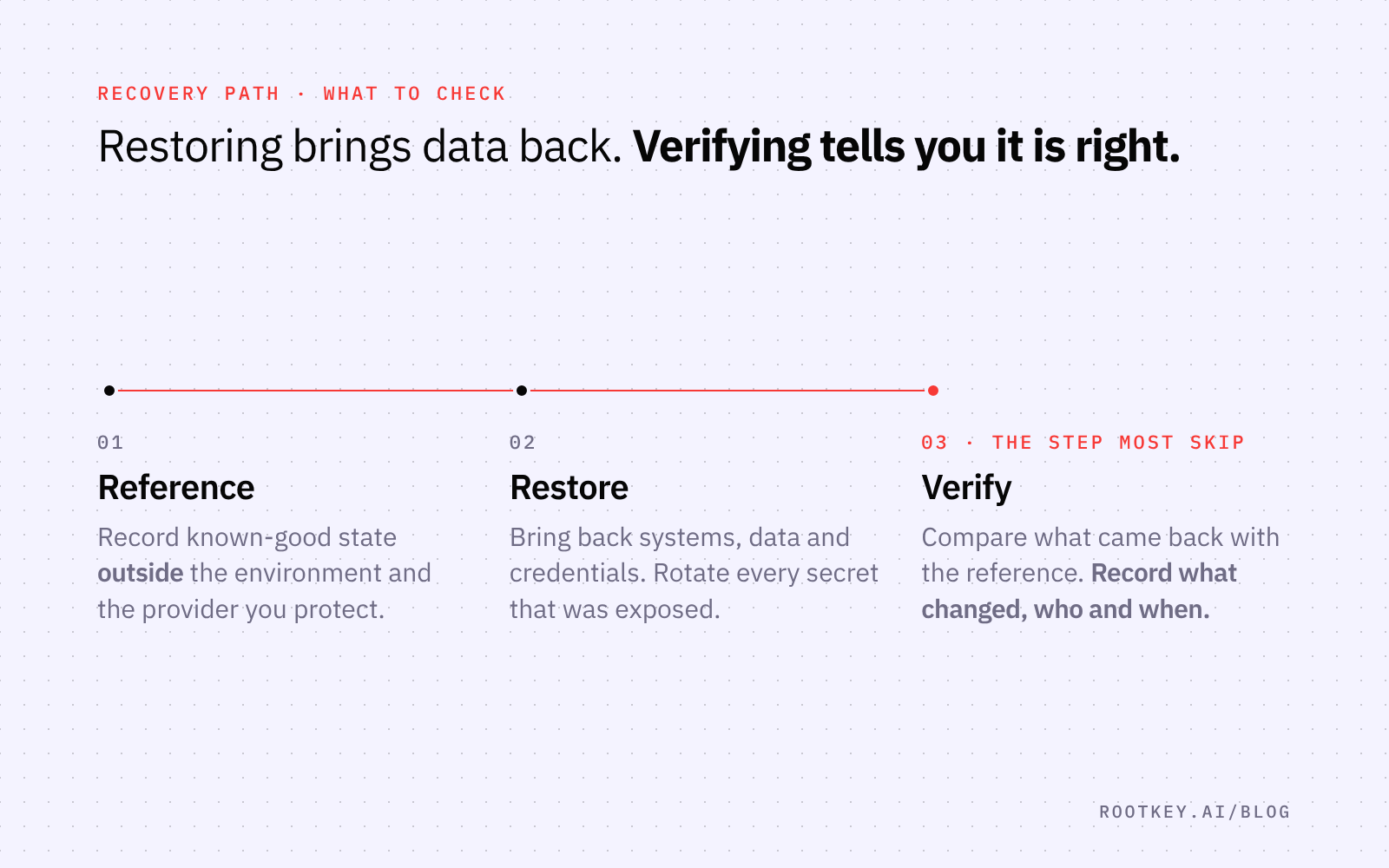
- Keep one reference of known-good state outside the environment you protect, and outside your provider's control plane.
- Test restores for correctness, not completion. Compare restored files and records with that reference.
- Verify artifacts before you deploy them. Pin versions and check builds and dependencies against fingerprints recorded independently.
- After an incident, rotate every exposed credential and confirm it. Then verify the data you restored, not only the access you revoked.
- Record each check with a time and an owner. It becomes the evidence your incident report and your auditors will ask for.
Where ROOTKey fits
ROOTKey seals a fingerprint of your files and records in an independent registry, outside your infrastructure and outside ours. When you restore, it compares the result with that reference and shows exactly what changed, who changed it, when and from where, so you can bring back the last verified version of a single file or row. It adds a layer of proof to the recovery tools you already run.
See how the platform works or talk to our team.
Sources
- BleepingComputer: Ransomware attack disrupts Japan's IDCF Cloud used by government clients
- Tech Insider: IDCF Cloud ransomware, zones and backups
- BleepingComputer: CISA and FBI say SafePay ransomware has hit over 600 critical infrastructure organizations
- Datadog Security Labs: LiteLLM compromised on PyPI and Docker
- Unosecur: October 2026 cybersecurity incidents