
In October 2026, the Saudi Data and Artificial Intelligence Authority (SDAIA) published draft amendments to the Implementing Regulations of Saudi Arabia's Personal Data Protection Law (PDPL) for public consultation, open from 6 October to 5 November 2026. The change that matters most to security teams: controllers would notify SDAIA of a personal data breach within 72 hours of becoming aware of it, whether or not harm is likely. The drafts would also require controllers to store personal data within the Kingdom.
Nothing changes until the final text is published in the Official Gazette; the amendments would take effect 60 days later, according to Clyde & Co's summary.
What the drafts would change
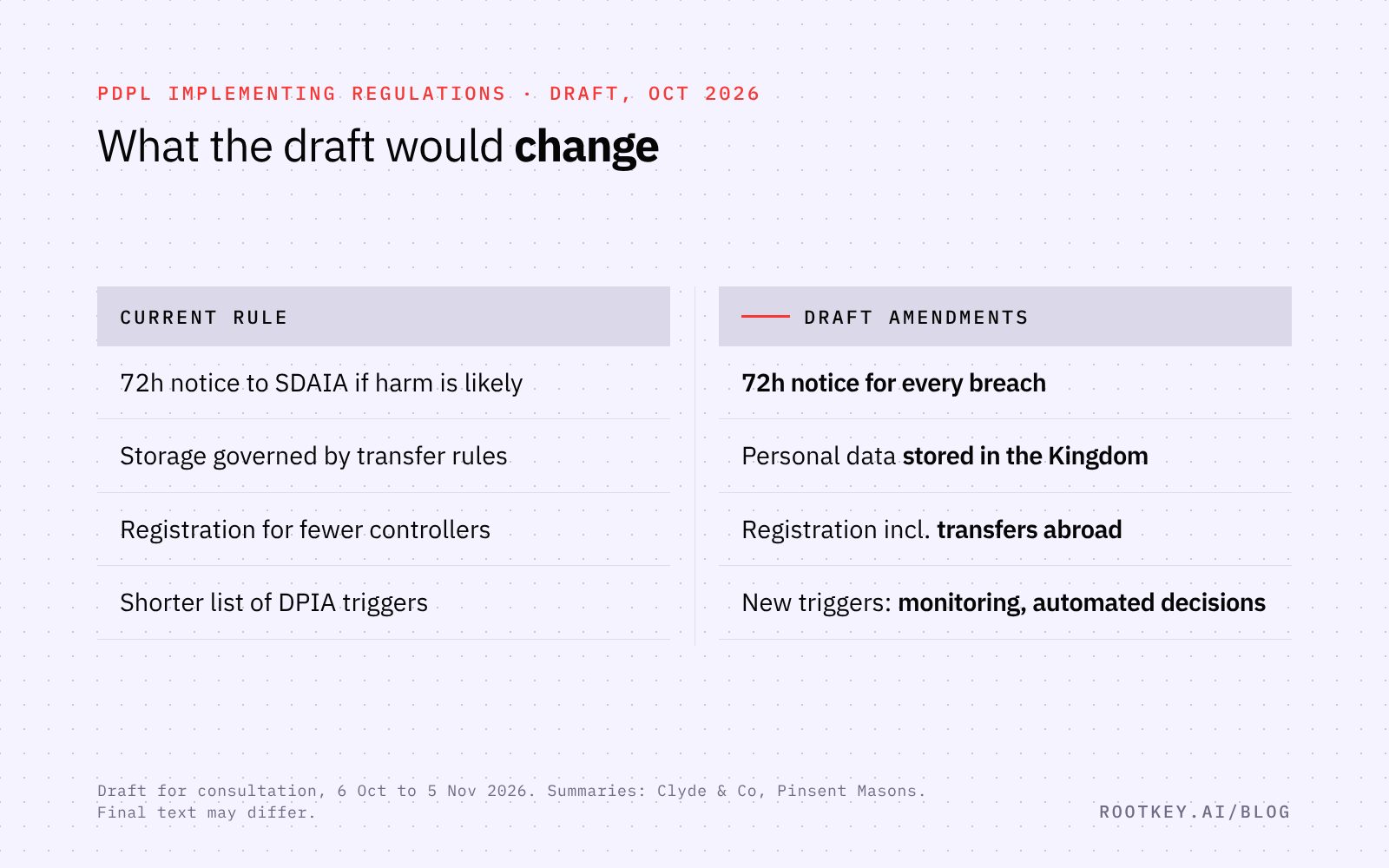
- Breach notification (Article 24). Today the 72-hour notice to SDAIA applies when a breach is likely to cause harm. The draft removes that test: every breach, within 72 hours of awareness. Notices to individuals stay tied to harm.
- In-Kingdom storage (Article 23). Controllers would store personal data within Saudi Arabia. Transfers abroad remain possible under the existing rules, but storage and transfer become separate questions, which matters for cloud replicas and copies.
- Registration (Article 34). Mandatory for more organisations, including controllers that process sensitive data and controllers that transfer or disclose personal data outside the Kingdom.
- Impact assessments (Article 25). New triggers, including large-scale or systematic monitoring, automated decisions and emerging technologies.
- Answering SDAIA. 20 business days to respond to the regulator's requests about how you implement the law, extendable on justification.
Why removing the harm test changes the work
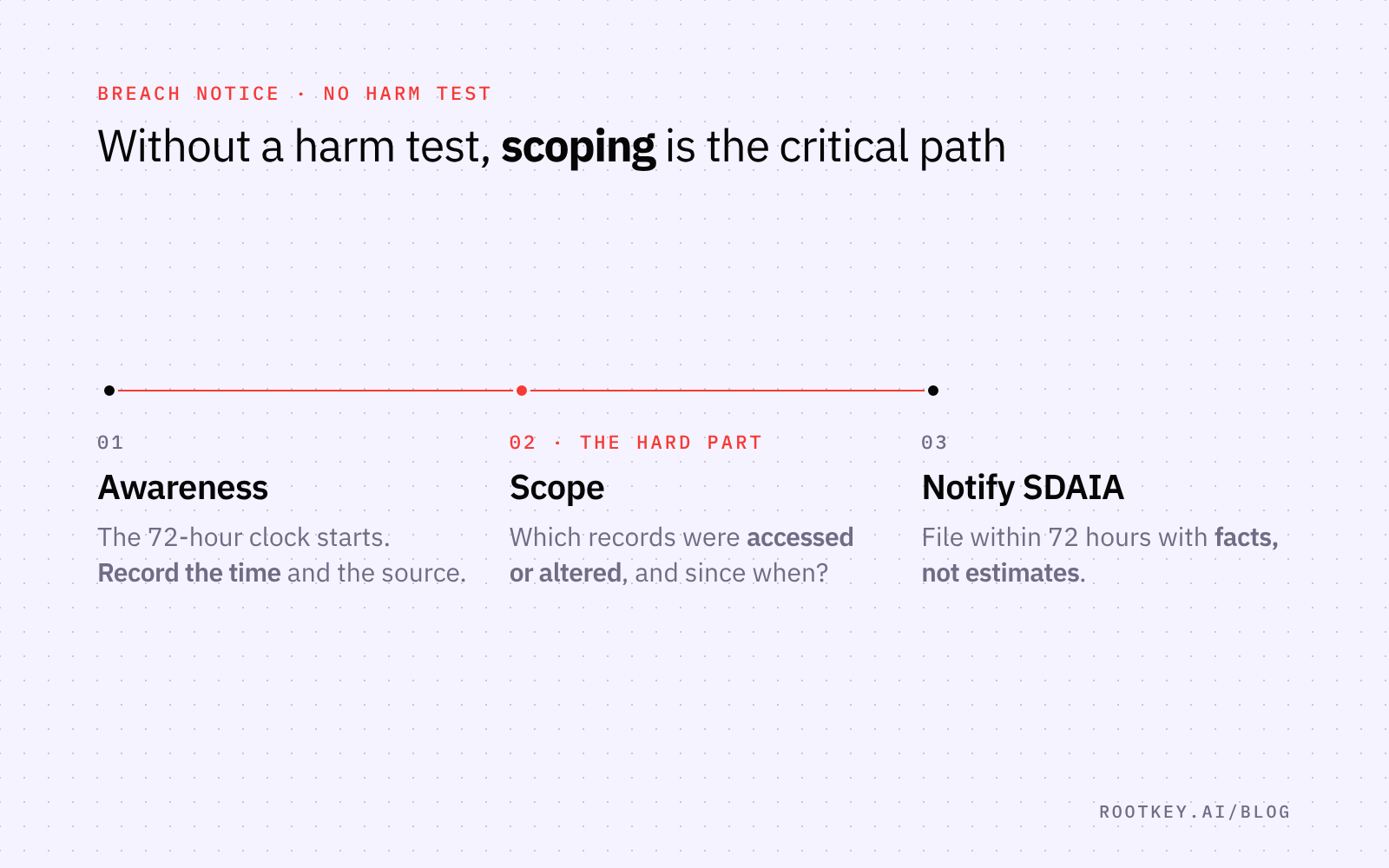
Under a harm-based rule, much of the first 72 hours goes into deciding whether a breach matters. Without the test, that decision disappears: the clock runs for every breach, and the notice has to say what happened.
The hard part moves to the facts. Which records were accessed or altered? Since when? Is the copy you restored the same as the one you had? An organisation that can answer from evidence it already holds files a short, accurate notice. One that cannot files a long, cautious one, and then revises it.
In-Kingdom storage does not prove the data is intact
Storing data in the Kingdom answers where it is. It does not answer whether it is still what it should be. A breach notice, an SDAIA request or an internal investigation will ask both. A verifiable record of each file's and record's state, kept independently of the systems that hold them, is what turns "we believe nothing changed" into a statement you can support.
What to do before the final text
- Map where personal data and its copies live, including replicas, exports and the copies you keep for recovery. A storage rule applies to all of them.
- Rehearse a 72-hour notice for a breach with no obvious harm. Time how long it takes to establish which records were touched.
- Record the moment of awareness. The clock starts there, and you will be asked when it was.
- Keep an independent record of the state of your data so you can show what changed and what did not.
- Check whether you will need to register under the wider Article 34 list.
- Read the final text when it is published. These are drafts; article numbers and wording may change.
For the basics of the law, see Saudi Arabia's PDPL and SDAIA: What International Companies Must Verify Before Entering the Kingdom. For the NCA's new controls for private companies, see NCNICC-1:2025 Backup Controls.
Where ROOTKey fits
ROOTKey keeps a sealed fingerprint of your files and records in an independent registry and shows what changed, who changed it, when and from where. When a 72-hour clock starts, that is the evidence a breach notice needs: which data was altered, and proof that the rest was not. ROOTKey deploys as SaaS, in a private cloud or on-premise.
If you are preparing for the final text, talk to our team.