

NCNICC-1:2025 is the National Cybersecurity Authority's set of cybersecurity controls for private-sector entities in Saudi Arabia that are not part of critical national infrastructure. Large entities (Category A) work against 65 controls; small and medium entities (Category B) against 26. One control that is mandatory for both is easy to read past: control 2-9-1-2, periodic testing to confirm that backups can actually be restored.
It sounds like housekeeping. It is also the control that exposes the gap between having a copy of your data and being able to show that the copy is right.
Who NCNICC-1:2025 applies to
The controls cover private-sector entities operating in the Kingdom that are not classified as critical national infrastructure and that the Authority notifies. Entities are sorted by size, and either headcount or revenue can place you in a category:
- Category A (large): more than 250 full-time employees, or annual revenue above SAR 200 million. Three main components, 22 subcomponents and 65 controls.
- Category B (small and medium): 6 to 249 full-time employees, or annual revenue between SAR 3 million and SAR 200 million. One main component, 13 subcomponents and 26 controls.
- Micro entities fall outside both categories.
- Government organisations and critical national infrastructure operators continue to work under the NCA's Essential Cybersecurity Controls (ECC), on which NCNICC-1:2025 was based.
Each control is marked mandatory or recommended for each category, and the Authority can require additional controls from any entity. The NCA's Arabic text is the authoritative version; the control numbers in this article follow the English translation in circulation.
What the backup control actually says
Control 2-9, Backup Management, exists to protect an entity's data and technical configurations from unexpected damage. For both categories it makes two things mandatory: periodic backups of sensitive business systems (2-9-1-1) and periodic testing to confirm that restoring those backups works (2-9-1-2). Category A must also review its backup requirements periodically; for Category B that review is recommended.
What the text does not set is just as telling. There is no frequency, no requirement for offline or isolated copies and no retention period. The control leaves the method to you, which means the evidence that your method works is also yours to produce.
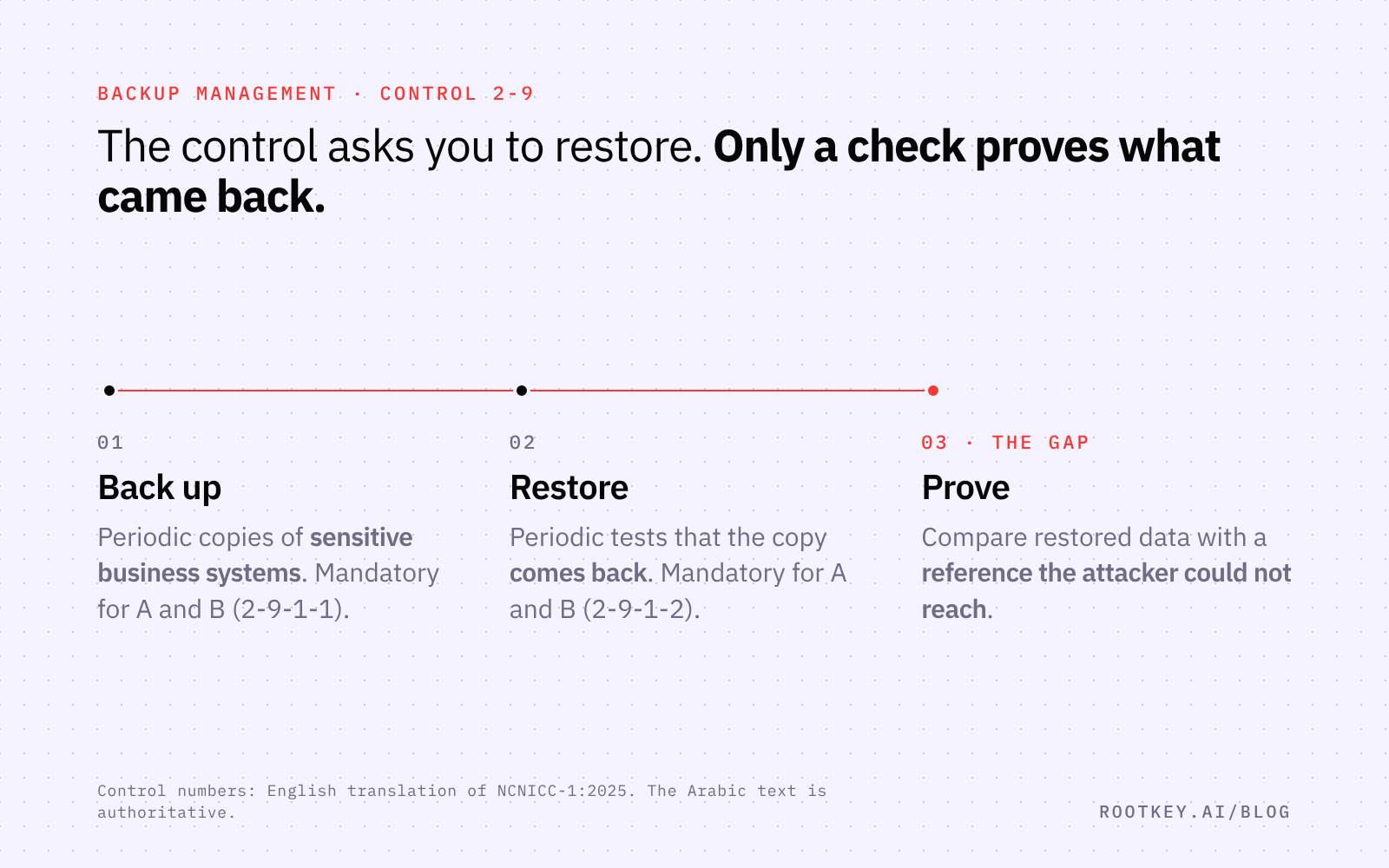
Why a successful restore test proves less than it seems
Most restore tests check that the job finished, the system starts and a sample of files opens. That confirms the copy came back. It does not confirm the copy is what it should be.
If an attacker altered records weeks before an incident, every backup taken since then holds the altered version, faithfully. The restore test passes. The data is wrong. And if the record of what correct looked like is kept inside the same environment that was compromised, comparing against it only tells you what the compromised system believes. We went through the full set of checks in Data Recovery Is Not Data Integrity Verification.
Three questions a restore test should answer
- Is the restored data identical to a known-good state? Not just readable, but the same, file by file and row by row.
- Identical against what? The reference has to sit outside the systems you are restoring, or an attacker who reached the data could have reached the reference too.
- If something differs, can you say what changed, who changed it and when? That is the first thing an assessor, a regulator or your own board will ask.
Where restore testing meets the rest of NCNICC-1:2025
The backup control does not stand alone. Several other controls depend on the same thing: evidence that still holds up after an incident.
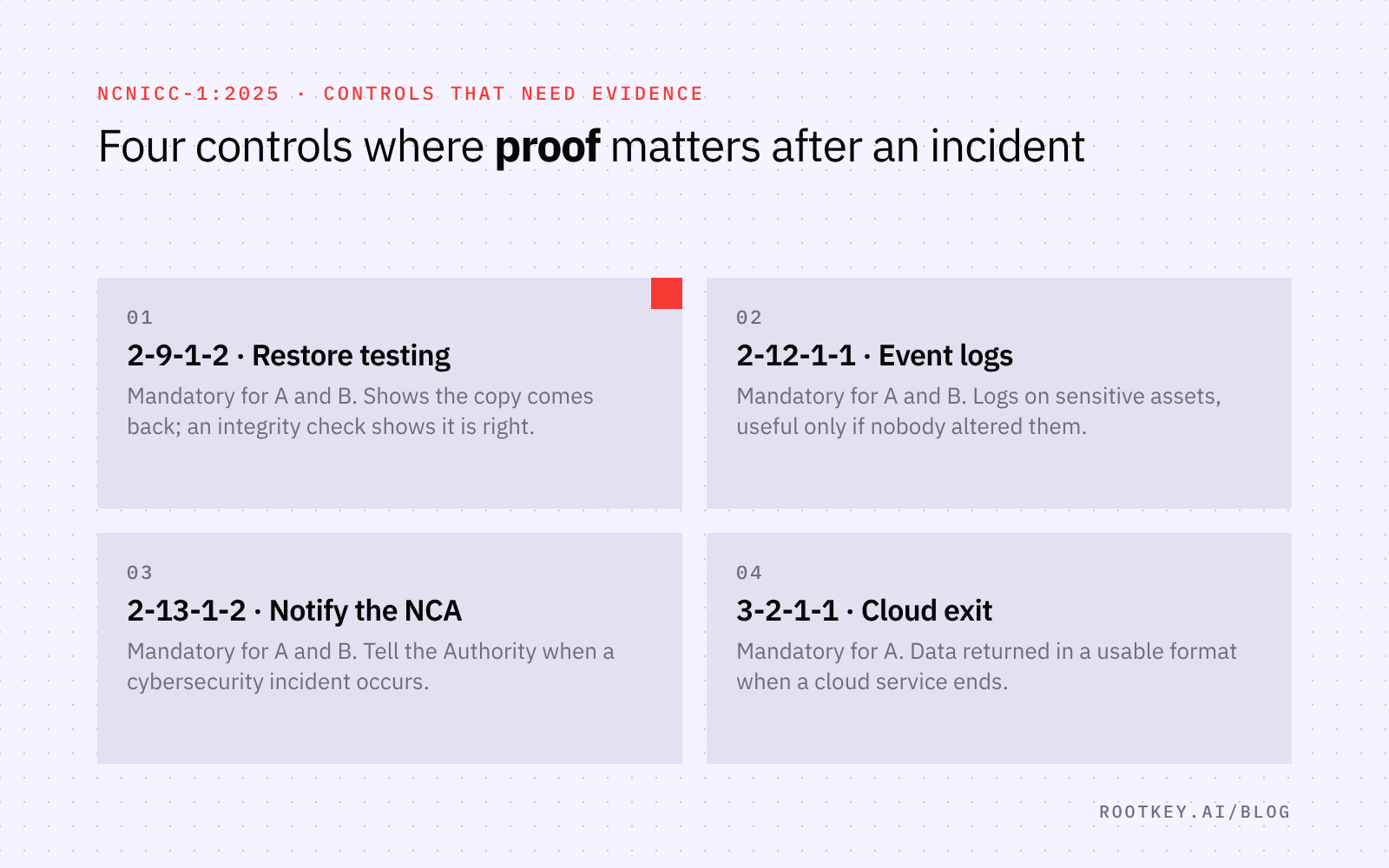
Personal data adds a second regulator. When a breach involves personal data, SDAIA will consider whether the organisation had appropriate safeguards in place, including those referenced in the NCA's controls, according to CMS's analysis of the new controls. We covered the data protection side in Saudi Arabia's PDPL and SDAIA: What International Companies Must Verify Before Entering the Kingdom.
What to do this quarter
- Confirm your category. Check headcount and revenue against the thresholds; either one can place you in scope.
- List your sensitive business systems. The backup controls apply to them, so that list is the scope of your restore tests.
- Add an integrity check to every restore test. Compare restored data with a reference recorded before the incident, and keep the result.
- Keep the reference outside the perimeter. A separate folder or account is not enough if the same administrator credentials can reach both.
- Treat test results as evidence. Control 1-4-1 expects compliance to be reviewed by a party independent of the cybersecurity function; dated, verifiable records make that review short.
- Read the Arabic text to confirm the exact wording of each control before you finalise policies.
Where ROOTKey fits
ROOTKey records a sealed fingerprint of your files and records in an independent registry, outside your systems and outside ours, before anything goes wrong. After a restore, it compares what came back against that reference and shows what changed, who changed it, when and from where, down to a single file or row. It works alongside the tools you already use to copy and restore data and replaces none of them. ROOTKey deploys as SaaS, in a private cloud or on-premise.
If you are scoping restore tests under NCNICC-1:2025, talk to our team.