

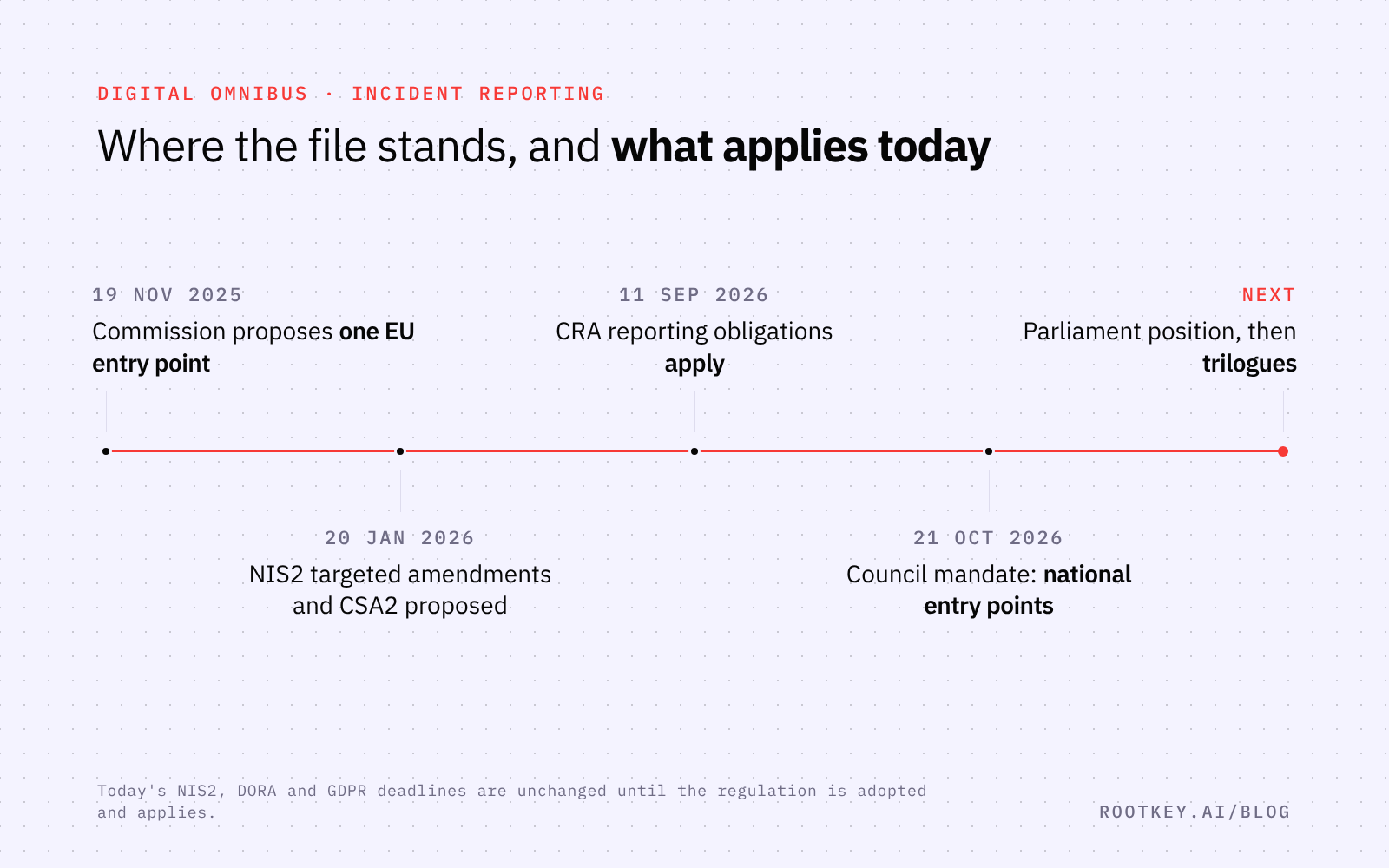
On 21 October 2026, the Council of the EU agreed its negotiating position on the Digital Omnibus, the package that simplifies parts of the GDPR, the e-privacy rules and EU cyber incident reporting. For incident reporting, the headline change is structural: the Council replaces the single EU-level entry point proposed by the Commission with a national entry point in each member state, plus an incident reporting information point at EU level.
The European Parliament has not adopted its position yet, so nothing changes for organisations today. What follows is what the Council's text would change, and the part of incident reporting it cannot touch.
What the Commission proposed
The Commission published the Digital Omnibus on 19 November 2025. Its idea was one entry point, run by ENISA, through which an organisation could file the notifications it owes under NIS2, the GDPR, DORA, eIDAS and the Critical Entities Resilience Directive, instead of separate filings to separate authorities.
The proposal also extends the GDPR deadline for notifying a personal data breach to the supervisory authority, from 72 to 96 hours, and the Council has backed that extension. In the Council's text, as RegReportingDesk reads it, the duty applies to breaches likely to result in a high risk.
What the Council changed
- National entry points instead of one EU portal. Each member state sets up an entry point that supports reporting under the different EU laws.
- An EU-level information point that documents how each member state's notification process works. According to RegReportingDesk's reading of the Council's text, it cannot accept, transmit or store notifications itself.
- Provisions toward a harmonised notification framework, including for incidents that cross borders.
- A longer runway. On the same reading, reporting through the national entry point becomes an obligation 30 months after the regulation enters into force, a longer period than the Commission proposed.
What does not change
For anyone handling an incident this quarter, the practical answer is: nothing. Current procedures stand until the regulation is adopted and its dates apply. Our NIS2, DORA and GDPR pages cover each regime in full.
- NIS2 still asks for an early warning within 24 hours of becoming aware of a significant incident, an incident notification within 72 hours and a final report within one month.
- DORA keeps the content and time limits for major ICT-related incident reports set in Delegated Regulation (EU) 2025/301. The Council's text does not amend them.
- The GDPR 72-hour breach notification applies until an amended Article 33 applies.
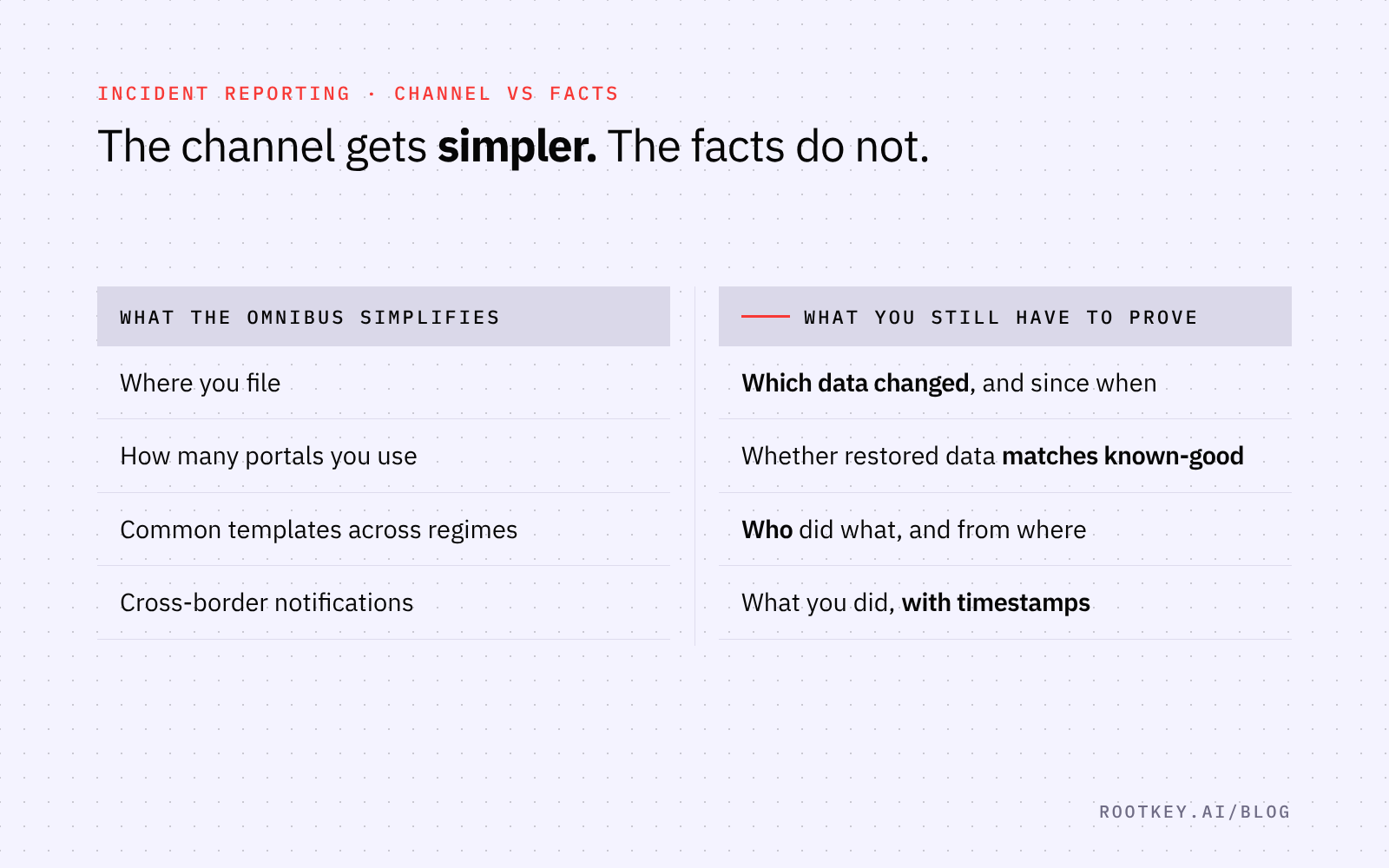
- The substance of a report stays the same: what happened, when it started, what was affected and what you did about it.
The part a single channel cannot fix
A national entry point reduces the number of portals and forms. It does not answer the questions those forms ask. Was data altered, or only encrypted? Which records? Since when? Is what you restored the same as what you had? Those answers come from evidence that existed before the incident, not from the channel you file through.
This is where dual-regulated organisations lose the most time. A financial entity that reports the same event under DORA and the GDPR builds the facts twice. We described one way to collect them once in DORA and NIS2 Overlap: Building One Evidence Layer for Dual-Regulated Financial Entities.
What to do now
- Keep current procedures. Nothing in the mandate applies yet.
- Map each incident type to every regime it triggers, so a future entry point is a routing change, not a redesign.
- Build one evidence record that every report draws from: timeline, affected data, integrity status and actions taken.
- Watch the European Parliament. Its position, led by the ITRE and LIBE committees, opens the trilogues that will settle the final dates.
Where ROOTKey fits
ROOTKey keeps a sealed fingerprint of your files and records in an independent registry and shows, for any incident, what changed, who changed it, when and from where. That is the factual core of an incident report, ready the day you need it, whichever entry point you file through. The platform generates NIS2 compliance reports today; DORA reports are coming soon.
Talk to our team about preparing your incident evidence.